MelSpectrogram
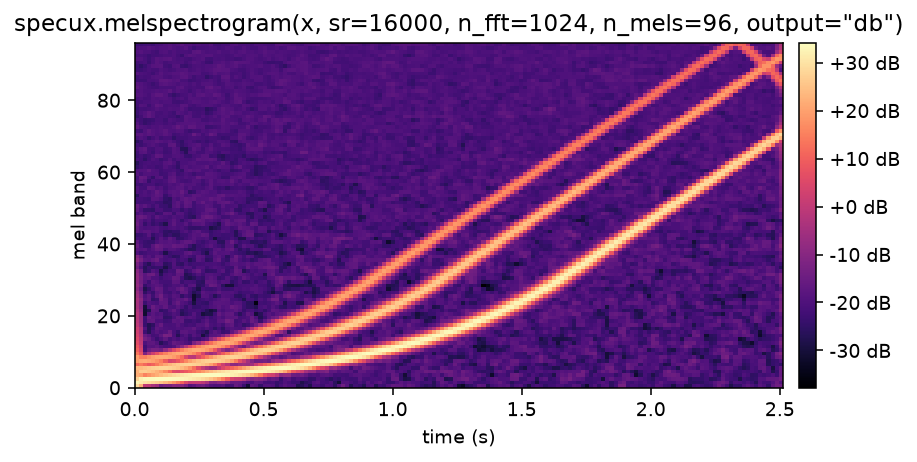
mel_filterbank @ |STFT|²: the power spectrogram reduced to
perceptually-spaced mel bands, the standard front end for speech and music
models. Fused into one kernel: each frame’s spectrum is reduced to mel
bands while still in shared memory; the spectrogram never materializes.
Cepstral coefficients on top of it are MFCC.
specux.melspectrogram(x, *, sr, n_fft=2048, hop_length=None, win_length=None, window="hann", center=True, n_mels=128, fmin=0.0, fmax=None, mel_scale="slaney", norm="slaney", power=2.0, output="power", eps=1e-10, backend="auto")import numpy as np
import specux
x = np.random.randn(8, 32768).astype(np.float32)M = specux.melspectrogram(x, sr=16000, n_fft=1024, n_mels=80)M.shape # (8, 80, 129) = (..., n_mels, n_frames)import torch
import specux
xt = torch.randn(8, 32768, device="cuda", requires_grad=True)M = specux.melspectrogram(xt, sr=16000, n_fft=1024, n_mels=80)M.sum().backward() # differentiable, on the GPU end to endimport cupy
import specux
xc = cupy.random.standard_normal((8, 32768), dtype=cupy.float32)M = specux.melspectrogram(xc, sr=16000, n_fft=1024, n_mels=80)M.shape # (8, 80, 129), stays on the GPU, no torchsr is required and keyword-only: the mel scale is meaningless without the
true sample rate. Leading dimensions pass through: (..., time) in,
(..., n_mels, n_frames) out.
Parameters
sr: sample rate in Hz.n_fft,hop_length,win_length,window,center: framing, as in STFT.n_mels: number of mel bands (default 128).fmin,fmax: filterbank range;fmax=Nonemeanssr / 2.mel_scale:"slaney"(default) or"htk"[stevens1937].norm:"slaney"area-normalizes each triangle [slaney1998];Nonekeeps peak-1 triangles.power:2.0for power (default),1.0for magnitude.output:"power"(linear mel energies) or"db"(10·log10(mel + eps)).backend:"auto","cuda","cpu", or"metal".
The filterbank itself
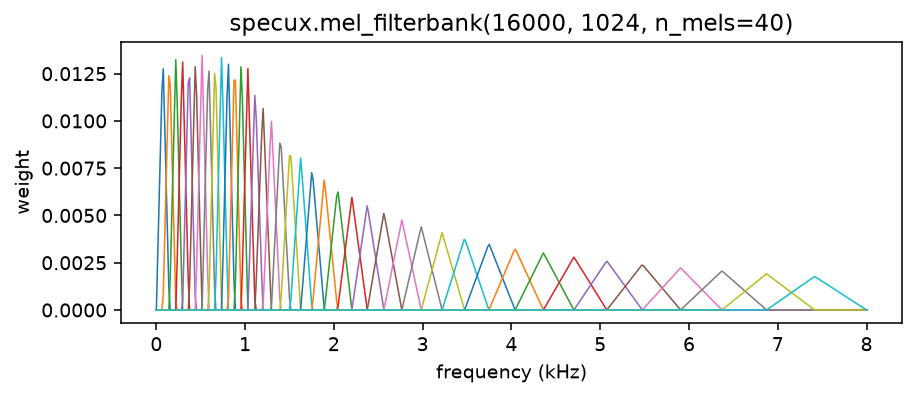
specux.mel_filterbank(sr, n_fft, n_mels=128, fmin=0.0, fmax=None, htk=False, norm="slaney") returns the (n_mels, n_fft // 2 + 1) matrix as a torch
tensor, the same one the fused kernel bakes in:
The scale converters behind it are public too:
m = specux.hz_to_mel(440.0) # 6.6 on the slaney scale (default)specux.mel_to_hz(m) # 440.0; htk=True selects the HTK formulaThey accept scalars or numpy arrays and are exact inverses of each other, for both the slaney and HTK scale formulas.
The configured form
specux.MelSpectrogram holds the parameters and broadcasts over any leading
shape; to_dict() round-trips the configuration:
t = specux.MelSpectrogram(sr=44100, n_fft=1024, n_mels=80)M = t(x) # (..., n_mels, n_frames)assert specux.MelSpectrogram(**t.to_dict()) == tThe torch Module for training pipelines is
specux.transforms.MelSpectrogram (window and filterbank registered as
buffers, nn.Sequential-ready).
References
- [stevens1937]: the mel pitch scale.
- [slaney1998]: the slaney filterbank convention.